
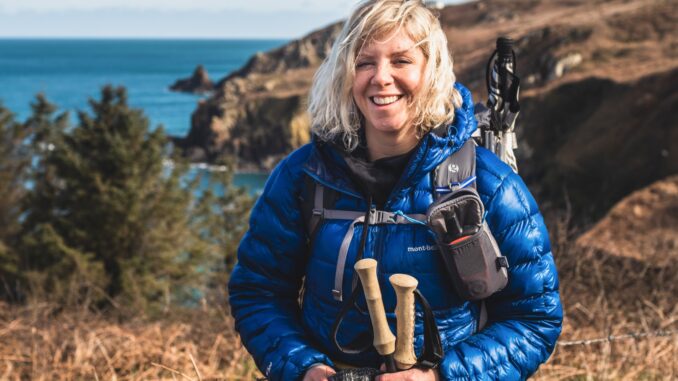
Gail Muller, adventurer, best-selling author, speaker, life coach and recent guest on The Switch, discusses resilience, and how redefining resilience can set you up for a rich and varied life.
The importance of resilience is spoken about a lot nowadays, often in relation to your work, wellbeing or self-help. There’s an idea that resilience is an innate skill. Someone is born with the skills to “power through” no matter what, and societally we praise these people: the people who can cope with it all, have it all. The flipside of this, however, is that we think less of those who seemingly don’t have it all, and we feel bad about ourselves if we feel unable to cope.
The three musketeers of success: resilience, perseverance, and self-worth
I would argue that resilience is more of a practice than an innate aspect of ourselves. Just as someone practises playing an instrument, or perfects their skills at a sport, resilience is something we can practise and get better at. Alongside resilience, there are other key skills that we can all utilise to instil hope and movement into our lives. I like to say that resilience, perseverance, and self-worth are the three musketeers of success.
Knowing when to quit is key to resilience. We think resilience is all about keeping going in the face of knockbacks, no matter what comes our way. However, although it might feel counterintuitive, resilience is about knowing when to stop, breathe and rest so that you can go again – potentially in a different direction.
Resilience isn’t just a physical thing. Resilience of the ego is more important than resilience of the body. As a person with chronic illness—I’ve been someone who didn’t have a very physically resilient body, but my spirit and my ego were resilient enough to carry on in a positive way. I truly believe that those people who don’t ever stop, and are praised for their endurance, don’t believe they can stop. They are worried what other people think of them, worrying about losing out on opportunities, and so they keep going until they burn out.
My own journey of perseverance is to do with my chronic illness and the journey of the nos. When I was in the depths of my chronic pain, I experienced many “nos” e.g. “No, we don’t have an answer for you”, “no, we can’t solve your pain”. When you hear “nos” from medical professionals who you have looked up to your whole life, it’s understandable that you take that as a final, definitive no. But with perseverance, you get creative about exploring different avenues and angles. Resilience and perseverance are closely related because you’ve got to have the resilience to know when to stop, and the perseverance to try again in a different direction.
The final musketeer is self-worth. Self-worth is that inalienable belief that whoever you are and whatever your experience—whether you’re laid up in bed with ME or depression, or chronic fatigue—it’s knowing that those things don’t delete or alter your inherent self-worth. You are still worth time, attention, and space in this world. You are still worthy.
Self-esteem is slightly different—you might have good self-esteem because of certain things, like you got a new job, or you look good in a certain outfit— but that’s to do with external validation. Self-worth will take you through if those things were to be removed, to the next day, to when the sun comes up again. Self-worth is knowing you are worth hanging on for. You are worth finding another way for, by using your resilience and perseverance.
Taking stock of yourself, from yourself and others
As I spoke about to Gee Footitt recently on The Switch, a podcast hosted by St James’s Place Financial Adviser Academy, resilience also means self-knowledge and self-awareness. It means taking stock of what decisions you’re making and considering your fatigue level. Are you handing in subpar work because you’re burning out? Are you feeling panicked or making the rash decisions because you’re worried about what people think?
Hearing feedback from others is difficult but it links to self-worth. We are bombarded by what other people think, whether it’s in a look, a glance or direct feedback. We must know how to filter this because it’s risky to derive sense of self from other people.
Having an honest dialogue with yourself is important, even if you’re looking in a mirror and don’t like some of the stuff you see. An honest conversation with yourself puts you on a firm footing to be able to open the door and seek feedback from other people—which you’re going to get whether you like it or not anyway.
Once you know your inherent self-worth and value, as well as your flaws, then it’s harder for you to feel unseated when you receive negative feedback—you already knew that stuff about yourself anyway. It’s when we’re blind to ourselves and unaware or avoiding certain parts of ourselves that we are bowled over in pain when someone points directly to it.
Exercises to train your inner voice to feed your self-worth
What I see from clients is that when someone wants to make a big change in their life such as a career change, they have often written it off before they’ve even started. They have strong negative inner voices in their head telling them they can’t, and they give up before they’ve even tried.
Your inner voice can often be more negative than positive. Your inner voice is there to keep you safe, but it is often loud and shouty and can wear your spirit down more than keep you safe. Its intention is good, but it often goes overboard.
A good thing to do is to remind yourself of all the things that you’re good at. Write affirmations such as in your journal—or in your work diary if you think journals are absolute bunk! Write in your work diary phrases like, ‘I am kind’ or ‘I am a good egg’. Remembering how you put good into the world will help you to see more good in the world.
When it comes to making a switch in life, people are also frightened of genuine concrete stuff like being able to pay the bills, pay rent, or take care of elderly relatives. These reasons are absolutely valid, but there are still opportunities to take what I call micro-leaps forward.
Micro-leaps are an education in bitesize chunks, such as watching YouTube videos, reading books, keeping a little book where you can store snippets of knowledge as well as your plans for future learning. For example, you could write in your notebook today I watched a ten-minute YouTube video while I prepared my grandad’s medicine and I learned ABC things, and tomorrow I’m going to learn XYZ things’. By the end of the six months, you’ll be feeling supremely confident in your abilities, and you’ll have an idea of your future plans.
Marrying a change in mindset to a change in environment
A change in environment can be very helpful to making changes in life. The more you can take yourself away from entrenched patterns, the better you’re able to think differently for a minute, and then you’re able to port that thinking back into your everyday life. It’s very difficult to have a completely fresh perspective when you’re surrounded by the same noise, thinking and people as usual, jobs, obligations, everything.
A change in environment is very dependent on someone’s physical or financial means. It doesn’t have to mean moving to a different country, whether it’s a different route to work or going to a coffee shop you’ve never been to before. When you go to that place, it can be your trigger to think about the life change you’re planning. It can be a safe space to flow, daydream and think about that life change.
Redefining your approach to resilience is a powerful step to taking charge of your life. Through redefining resilience, broadening your understanding of perseverance and self-worth, as well as practises such as affirmations, micro-leaps and changing your environment, you can help yourself seek the life that you daydream about.
