
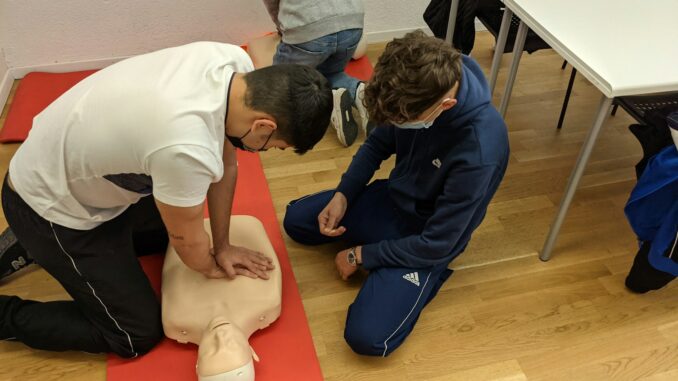
When a person suffers a cardiac arrest outside a hospital, survival depends on what happens in the next few minutes. For too long in the UK, bystanders have stood frozen, unsure how to help. But imagine if every young person leaving school carried the knowledge and confidence to perform CPR. Survival rates for cardiac arrest could double, turning schools into the training grounds for the next generation of lifesavers.
Why CPR in Schools Matters
Cardiac arrest can strike anyone, anywhere, regardless of age or health history. In the UK, more than 30,000 people a year experience an out-of-hospital cardiac arrest, and tragically, fewer than one in ten survive. The key factor in those grim statistics is delay: if CPR isn’t started immediately, the chances of survival fall by 10% every minute.
Teaching CPR in schools is not just about health education; it’s about equipping every child with a practical skill that could save a life. It is a uniquely powerful form of empowerment: a 14-year-old student could be the difference between tragedy and survival for a family member, friend, or stranger.
Government Action: A Step in the Right Direction
In recent years, the government has recognised this potential. CPR training was added to the secondary school curriculum in England in 2020 as part of compulsory health education. Scotland and Wales have also made commitments to integrate CPR into schools, while Northern Ireland has pushed localised initiatives.
This was a significant step forward, but the policy is still uneven in its application. Not every school has the same resources or time to dedicate to hands-on practice. Critics argue that without consistent support, CPR may be taught in theory rather than embedded as a practical skill. For CPR education to truly take root, it needs to be standardised, reinforced, and refreshed throughout a pupil’s school years.
What Other Countries Have Achieved
International evidence demonstrates the transformative impact of school-based CPR training. Denmark is the standout example: since 2005, CPR lessons have been compulsory in schools and for obtaining a driving licence. The results are remarkable: bystander CPR rates have tripled, and survival rates from out-of-hospital cardiac arrest have risen significantly.
If the UK follows through with similar ambition, the potential gains are huge. Studies suggest that widespread CPR training could save thousands of lives each year by ensuring that more people receive immediate chest compressions before emergency services arrive.
Young People as Catalysts for Change
Training children and teenagers in CPR creates a ripple effect beyond the classroom. Students bring their knowledge home, often teaching parents, siblings, and friends. The impact multiplies, gradually raising awareness and confidence across entire communities.
Young people are also more receptive to new skills and less burdened by the fear that stops many adults from intervening. Where older bystanders may hesitate out of anxiety about “doing it wrong,” young people who have practised CPR in school are more likely to step forward without hesitation.
Practical Training Over Theory
For CPR training in schools to be effective, it cannot stop at textbooks or videos. It must involve practical sessions with mannequins, repeated enough times to build muscle memory. The British Heart Foundation, St John Ambulance, and the Resuscitation Council UK have all provided free resources to schools; however, implementation requires dedicated time and teacher training.
Some schools are experimenting with innovative approaches, such as short refresher sessions at the start of each year or integrating CPR practice into physical education classes. The more natural and routine it feels, the more likely pupils are to act instinctively in an emergency.
The Defibrillator Factor
CPR training in schools also naturally pairs with awareness of Automated External Defibrillators (AEDs). These devices are increasingly available in public places, yet many people remain unaware of how easy they are to use. By teaching students both CPR and AED skills, schools ensure the next generation will not only start compressions but also confidently grab and apply a defibrillator.
This dual knowledge is what transforms survival statistics. Together, CPR and defibrillator use can increase survival rates by as much as 70%.
A Campaign Worth Supporting
Making CPR training universal in UK schools is a cause that appeals across society. It is low-cost, easy to deliver, and carries an enormous public health benefit. Campaigners are calling for clearer government funding, stronger accountability, and integration across all school years.
Parents, teachers, and healthcare leaders alike are rallying around the idea because it speaks to a basic human instinct: we all want to know that our children could save a life if needed.