
Amid a raging mental health crisis, apps and practices like mindfulness hold an undeniable promise. They’re scalable, affordable and always available from the comfort of your own sofa. There are just two problems: most of these apps, it turns out, lack both solid evidence that they work and an appeal for people to use them.
97% of users abandon a wellbeing app in the first two weeks, while half the studies done on Calm and Headspace show no positive effects of daily use. Multi-year research across 28,000 students has found that mindfulness training did not improve mental health – and one reason, according to the researchers, was that students were not engaged enough to actually practise.
“Many e-mental health programs are overly pedantic, didactic, and cognitively focused,” write Hanneke Scholten and Isabela Granic, two research psychologists pioneering a radical new approach to wellbeing – games. Scholten and Granic are co-directing a Canada- and Netherlands-based lab that’s working with artists, programmers and designers to develop and evaluate mental health games backed by science. “Well-designed applied games are intrinsically motivating, offer a strong sense of agency, and are simply fun. They also provide a compelling virtual playground to not only gain knowledge, but also practice skills.”
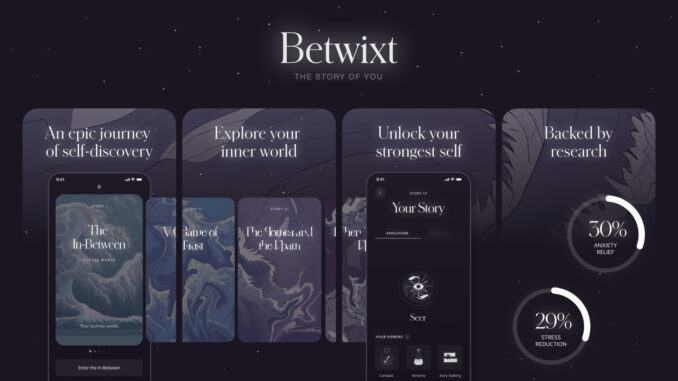
In 2021, Scholten began working with Betwixt – a choose-your-own-adventure app that takes users on a journey of self-exploration. It takes the form of an interactive story that casts you as a lone traveller stranded in the In-Between – a strange dreamlike world that responds to your thoughts and feelings.
Betwixt was founded by therapist Hazel Gale and science writer Ellie Dee, who felt that something key was missing in mental health and wellness tech – a compelling creative experience that inspires curiosity and makes you excited to learn about yourself.
Gale and Dee teamed up with Natalia Theodoridou, a World Fantasy Award winning author and game designer, to create a fictional world that would captivate users while delivering wellbeing benefits almost as a side effect. Dee said:
“We heard people describe self-care as a chore. For neurodivergent users, especially, sticking with a wellness app can be close to impossible and the common advice – to just keep practising – can feel patronising, not to mention unhelpful. So we said to ourselves ‘let’s go make it epic.’
Many users told us that they came for the story and ended up hooked on the self-insights. As creators, we were thrilled because narrative and play are not only engaging, they’re also how humans have made sense of themselves for thousands of years.”
Only about 3% of mental health apps are backed by research, most of it conducted by insiders, whose financial stake in those apps could bias the results. Betwixt, by contrast, opted for an independent study, one that was also a randomised controlled trial, the gold standard in evidence-based research.
While the ability to engage users may explain some of Betwixt’s mental health effects, there’s another factor Gale and Dee believe underlies its benefits: the power of play. According to neuroscientist Dr. Andrew Huberman, play is the best known tool for neuroplasticity – or the brain’s ability to rewire itself in response to experience.
Play creates a low-stakes environment that enables us to explore new possibilities in a way we wouldn’t dare to in real life, and this exploration enhances our creativity, makes us more flexible decision-makers, broadens our perspectives and stretches our emotional range. Children at play are not merely having fun; they’re learning new social skills, rehearsing for and internalising adult life.
Gale says she’s heard from users who’ve been exposed to analytical styles of therapy and found it helpful but inadequate. Rationally, they understand the maladaptive thinking patterns spurring negative emotions and behaviours, but understanding the problem doesn’t necessarily solve it. “Realising what’s wrong doesn’t automatically lead to change. We learn best experientially, not in a didactic way. And play is a great vehicle for embodying learning, for embedding change.”
In Betwixt, you aren’t simply taking in information and self-reflecting; you’re acting out a new story, bringing in your creativity and imagination, and actively reconstructing your inner narrative. And this, Gale says, can be transformative. She remembers one user who created an embodied form for his crippling self-doubt – a bison called Doubt. Now anytime his social anxiety flares up, he tells himself “it’s just my woolly, slightly overprotective friend being worried about me.” Turning his self-doubt into a friendly creature he could picture and address made it easier for him to deal with what was previously a nebulous, overwhelming emotion that would defy his grasp.
“We’ve learned that when you create a safe, playful space around personal problems, something magical happens. You’re transported to another world and that allows you to see your life in a whole new way and to realise that there’s always a better story waiting for you if the old one has outlived its usefulness,” Gale said.
