
By Joe Fernandes, founder and CEO, BuzzStreets
Whether it is by reducing staff distraction or by helping management introduce efficient practices, there are many ways and means for hospitals and patients to save time and money with a digital location and navigation system.
Missed appointments, or arriving late, and staff being stopped by people asking for directions – all use up hospital resources. Hospital managers I have spoken to in both the UK and Portugal, estimate the cost of poor wayfinding, for each hospital, each year to be over a million Euros.
How technology is changing Wayfinding
When Wayfinding is working well it means:
- you know where you are
- you know where you want to be
- you have an effective route to your destination
- you easily recognise your destination when you reach it
- and you know how to find your way back.
Global positioning systems are part of everyday life. Millions of people and vehicles are guided down roads and pavements every day by reliable digital navigation, and technology can create a sat-nav for indoors, not just outside. But unlike car sat-nav, the system is accurate to 1-2metres as the ‘sensors’ are within the hospital (not 12,000 miles away in space).
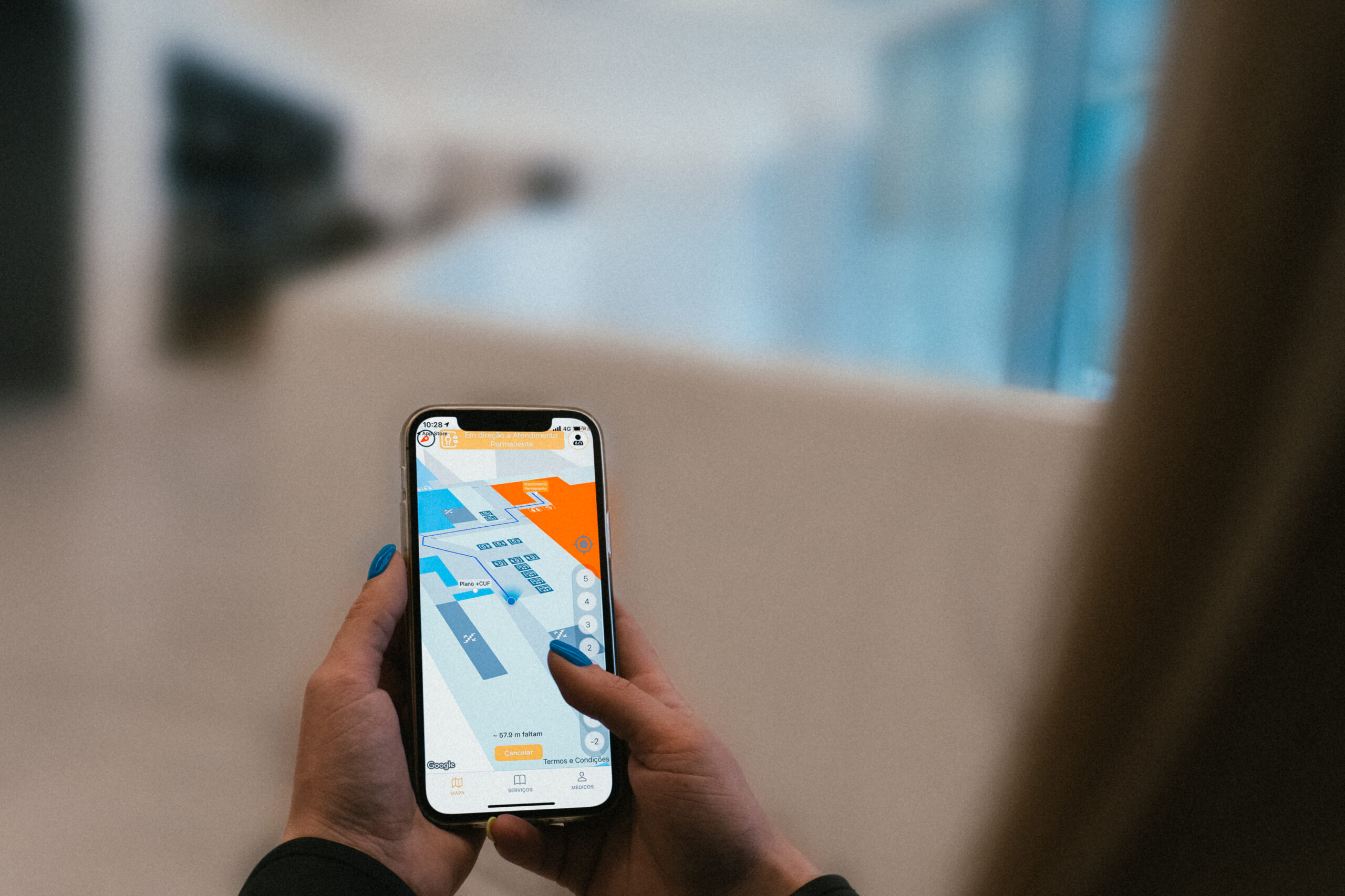
One example is the BuzzStreets Wayfinding system, already being trialled in a number of hospitals including the Chelsea and Westminster in London. BuzzStreets helps visitors navigate through the hospital providing a more independent experience as the navigation app can personalise the route: the app can choose the fastest or the least busy route; if you want/need to avoid stairs, the app will show you how; it can even highlight interesting features (such as art on the corridor walls) along the way.
“The BuzzStreets pilot project has already shown that the app reduces frustration for staff and visitors alike,” says Vanessa Sloane, Deputy Chief Nurse at Chelsea and Westminster Hospital NHS Foundation Trust. “Overall, we’ve seen that the app helps save resources, improve patient outcomes, and enhances the entire hospital experience for patients and their families.”
Here are five ways digital location and navigation system can improve experiences for patients and staff and ease the strain on hospital resources:
- Wayfinding for Staff
Research involving UK teaching hospitals looking at doctors’ expectations and experiences noted that many participants mentioned getting lost and reported that, particularly when working on large sites, route optimisation was a vital part of task prioritisation, and that this was most important during crash calls. These are situations where staff are under time pressure and may be called to a ward that they have not been to before. Almost half of participants reported becoming lost on the way to a crash call.
One participant said: “Lots of experiences getting lost, need to ask nurses or hope you bump into someone else on a crash call. Even when you know where to go, you often don’t go the best way.” (Source: British Medical Journal)
- Tracking equipment
Digital Wayfinding systems can allow staff to trace equipment that is regularly moved around a hospital (e.g. wheelchairs) thus avoiding time wasted searching for them, or considering an item lost as no one knows where it is, and so a new one is ordered. Again, a saving of both time and money.
- Patient safety
A digital navigation system can assist with the daily safety management of patients with mental health problems/diseases (Parkinson, circumstantial or profound amnesia, Alzheimer’s, etc.). These patients can be tracked, and if they become lost within healthcare buildings, staff can more easily aid them back to their ward.
- Hygiene help
A digital navigation system that gathers information about routes and traffic of patients and professionals can assist with a hospital’s cleaning and disinfection routines by identifying the areas of the hospital experiencing the highest levels of traffic, the type of traffic, and the dayparts where traffic is heaviest. This information allows managers to efficiently organise cleaning staff and target areas requiring more frequent attention.
- More than just a map
The advantage of indoor navigation apps is that the system can be much more than a reliable way to move from A to B. Other services—such as appointments, examination results, general hospital information, spaces available in the parking areas—can also be incorporated into a single mobile application. For example, BuzzStreets includes features such as a communication system between patient and doctor, the possibility of scheduling appointments, receiving medical scans and prescriptions in the app, heat maps, contextual notification, updated and edited locations, appointment reminders, and multilingual voice guidance.
ABOUT THE AUTHOR
Joe Fernandes, founder and CEO of BuzzStreets, an award-winning navigation platform, that enables organisations (hospitals, shopping malls, airports, offices, stadiums, etc.) to offer their customers an indoor way-finder that allows them to navigate inside the building. The client arrives at the entrance or reception and then uses the bespoke app to navigate to the specific location (room, shop, check-in, office, or even seat) they need. BuzzStreets also supplies movement analytics that can help improve building efficiency and keep track of vital equipment.
