

Better surveyed over 2,000 men to better understand gym culture, social media influence, and the importance of mental health among men, comparing those who workout as a team to those who exercise alone.
- One in 10 men has considered surgery as a result of pressures from social media, with this rising to 20% among 16-24-year-olds and 16% in the 25-34 category.
- A quarter of men agree exercising helps ‘get rid’ of their aggression.
- Tyson Fury, The Rock and Marcus Rashford were amongst the most influential for attitudes towards fitness.
A new study has revealed that two-thirds of men say social media impacts their body confidence in some way, and almost half say they would consider having had some kind of body modification. More than one in ten (12%) say this is a direct result of social media, which increases to 19% among 19–24-year-olds.
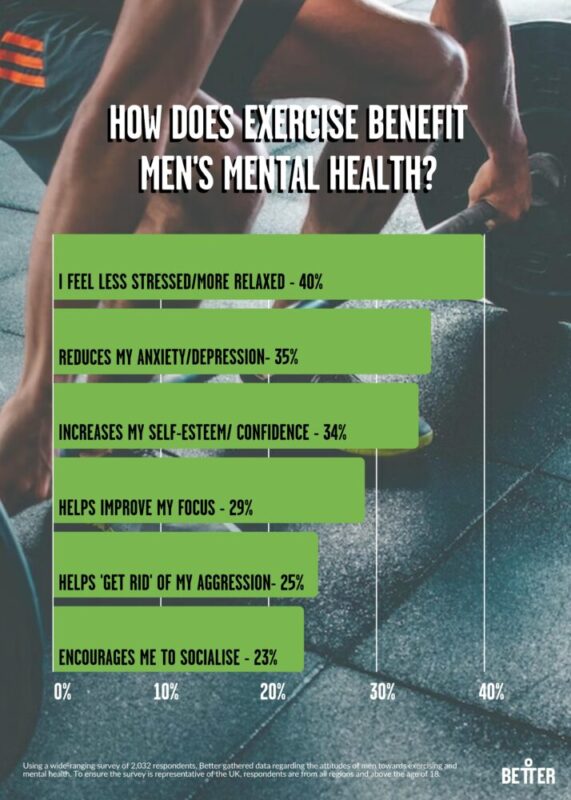
The survey from the UK’s leading leisure operator, Better, asked 2,032 men what role fitness, social media, and influencers play in their mental health. The study showed that a quarter of men said taking part in sports or exercising in some way helps ‘rid’ themselves of feelings of aggression. Interestingly, this was higher among those participating in team sports (28%) than among those working out alone (21%).
Meanwhile, 96% of men agree that taking part in sports/exercising has positively benefited their mental health. When asked, two in five men agreed that it reduced their stress levels, 35% stated it reduced their anxiety and depression, and a third agreed it increased their confidence.
A quarter of men chose online communities instead of their friends when struggling with their mental health.
The study also found that a quarter of men are reaching out to online communities to combat their mental health instead of turning to their friends, with a bigger 29% agreeing that online communities have helped improve their mental health. This was particularly popular amongst 25-34 year-olds with four in 10 men this age reaching out to communities online.
One in 10 men considers surgery as a result of pressure from social media.
However, social media is clearly having an impact on men, with younger men being the most affected by the images they see online. While 31% of 25-34-year-old men stated they feel pressured to look a certain way because of online images, 30% of 16-24-year-olds also agreed with this. For many, this has led to the feeling that they need to alter their bodies through body modifications, with 49% saying they have had or would consider undergoing surgery.
The most popular surgeries were teeth veneers (16%) and hair transplants (12%), however, a shocking one in 10 16-24 year-olds consider getting leg lengthening surgery, a radical surgery to grow between three to six inches that can set you back nearly £70k. One in 10 24-35-year-olds would also consider a full jaw reconstruction and 8% would undergo penile augmentation.
Andrew Tate was the most influential social media personality for young men
Viral social media figure Andrew Tate was the most influential among the 16-24 men category, with 29% admitting he had influenced them or someone they know. A recent YouGov survey [1] also discussed this, reporting 27% of 18-29-year-old men had a favourable view of Andrew Tate, and two-thirds (64%) of those with a favourable view agree with Tate’s views on masculinity and what it means to be a ‘man’. Interestingly, the controversial online figure has also encouraged homophobia amongst his followers, and yet Better found that 29% of those identifying as LGBTQ+ admitted to him influencing them too.
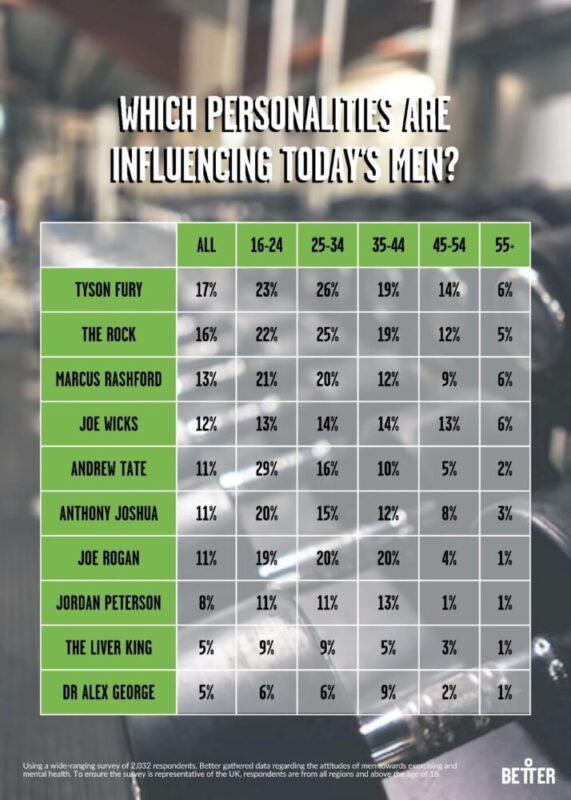
Tyson Fury was the most popular overall, influencing almost a fifth of men, increasing to a quarter for 25-34-year-olds specifically. In second place came The Rock with 16%, again being most popular amongst the 25-34 age range.
Positive influences like Mental Health Ambassador Dr. Alex George came much lower on the list, with only 5% of British men stating he’d influence them. However, 44% of those surveyed stated that no personalities had ever influenced them.
Those participating in team sports are more likely to check in with their friend’s mental health than those exercising alone.
When it comes to checking in on your friend’s mental health, it seems men think they are checking in more than they are. 45% of men stated they check in with their friends, while only 38% said their friends have checked in on them. Perhaps unsurprisingly, this decreased with age, as only 27% of those aged 55+ agreed they check in with their friends, compared to 58% of 25-34 year-olds and 54% of 16-24 year-olds.
